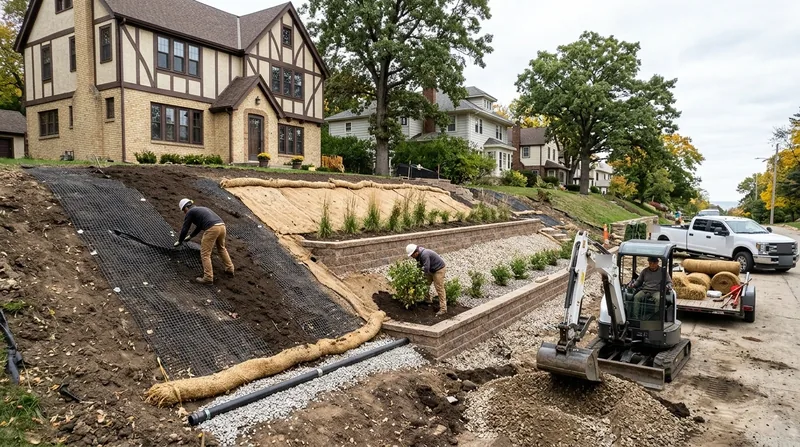




Milwaukee sits on ground that moves. The Lake Michigan bluffs on the East Side and North Shore, the ravines cut by the Milwaukee, Menominee and Kinnickinnic rivers, and the terraced front yards on rolling streets from Washington Heights to Wauwatosa all create grade changes that want to slide. Dense glacial clay holds water like a sponge, and hard freeze-thaw winters with deep frost heave push soil downhill year after year. Slope Stabilization & Erosion Control in Milwaukee means stopping that movement before it takes a driveway, a garage pad or a foundation wall with it. We build terraced walls, set geogrid reinforcement and fix the drainage that causes most failures. If your yard is washing out or a slope is creeping toward the house, call Milwaukee Retaining Wall at (414) 250-0691 for a free look.
Why Milwaukee Slopes Fail: Clay, Frost Heave and Old Walls
Most slope failures we see in Milwaukee are not sudden. They build over seasons. Glacial clay traps water against a wall or a bare bank, frost drives it deeper, and the spring thaw leaves the soil soft and heavy. On the bluffs and ravines, gravity does the rest. Old timber and railroad tie walls rot out and stop holding anything.
- Water saturates the clay and adds weight that pushes the slope downhill.
- Frost heave lifts and cracks walls, then leaves gaps for water to enter.
- Rotting timber and tie walls lose their grip and slide out of line.
- Bare banks wash soil onto sidewalks, driveways and into storm drains.
- Downspouts and gutter failures dump roof water directly onto the slope.
Fixing the drainage and reinforcing the soil is what makes a slope stay put through a Milwaukee winter.
Key info: A homeowner in Shorewood had a Lannon stone wall on a ravine lot that had leaned about 4 inches in two winters. The cause was a clogged clay layer behind the wall, not the stone itself. We rebuilt the drainage and tied the wall back with geogrid, and it has held through three freeze-thaw cycles.
Milwaukee building officials publish permit guidance for walls and grade changes, and it is worth reading before any slope work starts: City of Milwaukee permit information.
How We Stabilize a Milwaukee Slope, Step by Step
We start by reading the water. Where it enters, where it pools and where it exits decides the design more than the wall material does. Then we build in lifts, compacting and reinforcing as we go, so the finished slope handles frost and saturated clay instead of fighting them.
- We walk the slope and mark the water paths, the failed sections and the property lines.
- We check the local building department threshold for permits, since walls over about 4 feet or walls carrying a surcharge often need one.
- We excavate the failed soil and shape the slope into terraces that shed water instead of holding it.
- We install drainage stone, perforated pipe and filter fabric so water leaves the slope.
- We lay geogrid in layers behind the wall to tie the face back into the hillside.
- We build the wall or boulder face, compacting each lift of backfill.
- We seed, mulch or armor the bare ground above the wall so rain does not restart the erosion.
Every step is aimed at the same goal: keep water moving and keep soil where it belongs.
Key info: On a terraced front yard in Wauwatosa, the slope above the driveway was washing out every spring. We built two low block terraces with geogrid and a stone-filled drain at the toe. The driveway has stayed clear since, and the homeowner mows a stable yard instead of a mud channel. See how we handle this on the block and segmental retaining walls page.
Slope Stabilization Methods We Use Around Milwaukee
No single method fits every yard. A bluff lot in Whitefish Bay needs a different approach than a shallow bank behind a Greenfield ranch. We match the method to the slope height, the soil, the water and what the wall has to hold.
| Approach | Description | Best for |
|---|---|---|
| Terraced retaining walls | Two or more stepped walls that break a tall slope into shorter, stable lifts. | Ravine lots and steep front yards |
| Geogrid reinforcement | Layered mesh that ties the wall face back into the hillside soil. | Walls over 4 feet and surcharge loads |
| Surface drainage and swales | Shaped channels and pipe that carry water away from the slope. | Clay yards that pool and wash out |
| Boulder and riprap armoring | Natural stone placed on the bank to absorb water energy. | River banks and bluff edges |
| Erosion control seeding and mulch | Ground cover that holds topsoil until roots take over. | Bare banks above new walls |
We often combine two or three of these on the same slope, because water and soil rarely fail in just one way.
Slope Stabilization & Erosion Control Cost in Milwaukee: What to Expect
We start every job with a free estimate, and that estimate is where the real number comes from. Slope work is priced by the foot of wall, the height, the soil volume moved and the drainage required. Small erosion fixes cost far less than a full terraced rebuild on a ravine lot. Expect the final figure to track the scope, not a flat rate.
Four things move the price most: slope height and length, how much failed soil has to come out, whether geogrid or engineered drawings are needed, and how tight the access is. A backyard slope in Bay View with an alley behind it is easier to work than a bluff lot where every load of stone goes down a narrow stair. Getting two or three estimates is smart, and it lets you compare scope, not just numbers.
For a fuller picture of how we price walls and slope work, see our Milwaukee retaining wall pricing page.
Slope Stabilization & Erosion Control Near Me: How to Hire a Contractor Near Milwaukee
Hiring for slope work is different from hiring for a fence. The contractor has to read water, soil and grade, and the work has to hold through frost. Ask direct questions and check the answers before you sign anything.
- Confirm the contractor is fully insured, and ask for a certificate.
- Get two or three written estimates that spell out drainage and reinforcement, not just the wall face.
- Ask for references from jobs on similar slopes, and go look at them.
- Ask who pulls the permit, since Milwaukee-area building departments set their own thresholds for walls over about 4 feet.
- Check setback and property-line rules before the design is final, especially on narrow city lots.
A contractor who talks about water first and stone second is usually the one whose wall stays straight.
Ready to stop the erosion? Call Milwaukee Retaining Wall at (414) 250-0691 for a free, no-obligation estimate. Fully insured, serving Milwaukee and the surrounding communities.
Slope Stabilization & Erosion Control in Milwaukee: Pricing Guide
| Service | Price | Details |
|---|---|---|
| Erosion control and reseeding | Free estimate | Includes slope inspection and a written scope; price moves with square footage of bare bank. |
| Drainage correction and swale work | Starting at $1,800 | Covers trenching, perforated pipe and stone; rises with length and clay removal. |
| Terraced retaining wall stabilization | Starting at $4,500 | Includes geogrid, drainage and wall build; height and access drive the number. |
| Bluff or ravine engineered stabilization | On estimate | Needs an on-site look and often engineered drawings before any number is given. |
| Travel | Included | in Milwaukee and surrounding areas, no separate call-out or mileage fee |
| Estimate | Free | Response within 24h at (414) 250-0691, no obligation to book |
Indicative pricing, the exact cost depends on square footage, finish, and site access. Free personalized estimate within 24h at (414) 250-0691.


