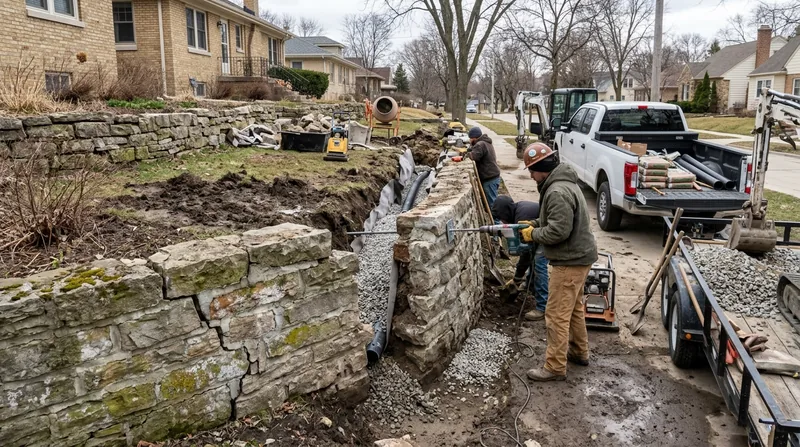




Retaining Wall Repair in Milwaukee
Milwaukee sits on ground that works against walls. The glacial clay under Bay View and Riverwest holds water like a sponge, and the Lake Michigan bluffs, the Milwaukee, Menomonee, and Kinnickinnic river ravines, and the terraced front yards on rolling streets give that water somewhere to push. When Retaining Wall Repair in Milwaukee is done right, it stops a leaning Lannon stone wall or a bowed CMU wall before a hard freeze cracks it apart. We handle the repair work: drainage correction, tieback anchors, partial rebuilds, and full section replacement. If you are already past the point of no return, see our leaning and collapsed wall repair page. If the wall is still standing, read on.
Why Retaining Walls Fail in Milwaukee's Clay and Frost
The failure mode that dominates here is not age. It is water trapped behind the wall combined with deep frost heave. Dense glacial clay drains slowly, so a wall built without proper backfill stone and weep paths saturates all fall, then freezes and pushes out. The 1900s Cream City brick cottages, Polish flats, and two-story duplexes on narrow lots in Bay View, Riverwest, and Walker's Point were built with short walls that were never engineered for today's runoff. The Arts and Crafts bungalows in Washington Heights and the Tudor revivals in Story Hill have the same problem on a smaller scale.
- We see walls that lean because the footing heaved a few inches over several winters.
- We find Lannon stone and poured concrete walls with horizontal cracks where the clay pushed back.
- We find timber and railroad tie walls in Wauwatosa and West Allis that have rotted at the soil line.
- We find segmental block walls in Franklin and Oak Creek that lost their base course because the drainage stone clogged.
Every one of these is cheaper to repair than to replace, provided you catch it before the wall rotates past the point of no return.
Key info: A wall in Shorewood that leans two inches after one winter is a drainage repair. The same wall leaning four inches after three winters is a rebuild. The difference in cost is often three to four times, which is why we recommend an inspection as soon as you see movement.
For the permit side, walls above roughly 4 feet from the footing, or walls that carry a driveway or structure surcharge, usually need a permit and sometimes engineered drawings. Thresholds vary by jurisdiction, so confirm with the City of Milwaukee Department of Neighborhood Services or your local building department before work starts: milwaukee.gov/DNS.
How We Diagnose and Repair a Failing Wall in Milwaukee
We start by finding out why the wall moved, not just where it moved. A bow in the face tells you nothing until you know whether the footing heaved, the drainage failed, or the soil behind the wall is pushing harder than the wall was built to resist. On the North Shore lakefront and the bluff lots, that often means checking for ravine seepage as well as surface runoff. We open test pits, check the base course, and look at the backfill before we quote a repair.
- We walk the wall and mark every crack, lean, and settled section with a level and a string line.
- We dig behind the wall to inspect the drainage stone, the weep holes, and the soil condition.
- We check the footing depth against local frost depth and look for heave or undermining.
- We recommend the least invasive repair that will hold, from re-grading and new drainage to anchors or a partial rebuild.
- We pull the permit if one is required and schedule the work around the frost window.
- We rebuild the drainage and backfill correctly so the repair does not fail the same way in five years.
The repair is only as good as the drainage behind it, which is why we treat retaining wall drainage as part of every repair, not an add-on.
Key info: On a 1920s duplex lot in Riverwest, we repaired a 3-foot Lannon stone wall by resetting the top three courses, adding a perforated drain and washed stone behind the wall, and re-grading the yard away from the house. The wall had leaned for years, but the footing was sound, so a full rebuild was not needed.
Repair Approaches We Use on Milwaukee Walls
Not every failing wall needs the same fix. The right approach depends on the wall material, the height, the soil, and how far the movement has gone. We use four main repair methods in Milwaukee, and we will tell you when a repair is not worth doing and a replacement makes more sense.
| Approach | Description | Best for |
|---|---|---|
| Drainage correction | We open the backfill, clear clogged weep paths, install perforated drain tile and washed stone, and re-grade the soil so water runs away from the wall. | Walls that lean or show damp spots but have not cracked structurally. |
| Tieback anchors | We drive steel anchors into the stable soil behind the wall and connect them to the wall face to pull a bow back toward plumb. | Taller CMU or concrete walls with a visible bow and no room to rebuild from the front. |
| Partial rebuild | We remove and reset the failed section, rebuild the base course, and tie the new work into the sound part of the wall. | Walls with a settled or heaved section, such as a corner that dropped after a wet spring. |
| Timber and tie replacement | We pull rotted timber and railroad ties and rebuild that section in segmental block or stone that will not decay. | 1950s ranch lots in Greenfield and West Allis with original tie walls at the end of their life. |
If the wall is already past repair, we will say so and walk you through retaining wall replacement instead of selling you a repair that will not hold.
Retaining Wall Repair Cost in Milwaukee: What to Expect
Most repairs in Milwaukee start around $1,500, and that figure covers small drainage corrections, resetting a few courses, and patching a cracked section on a wall up to about 3 feet. From there, cost climbs with wall height, access, and how much of the wall has to come apart. A tieback anchor job on a 6-foot CMU wall in Whitefish Bay runs well above that. A partial rebuild on a ravine lot in Mequon can run several times the starting figure because of the slope and the machine access.
Four things move the price most: wall height and length, how tight the access is (a narrow lot in Walker's Point costs more to work than an open back yard in Brookfield), whether the footing has to be replaced, and whether a permit or engineered drawing is required. We quote the repair and the drainage as one scope so you are not surprised later. Get two or three written estimates and compare what is actually included, not just the bottom line. Our full pricing overview breaks down the ranges by repair type.
Retaining Wall Repair Near Me: How to Choose a Contractor Near Milwaukee
When you search for retaining wall repair near me, the list you get is mostly companies that will give you a number over the phone. A failing wall needs someone who will put a shovel in the ground and look at the drainage before quoting. Ask three things before you hire: are they fully insured in Wisconsin, will they pull the permit if one is required, and can they show you recent repair work in Milwaukee, not just new installations. A company that only builds new walls will often recommend a replacement when a repair would have held.
Ask for references on jobs similar to yours, especially if you have a tall wall, a ravine lot, or a wall that supports a driveway. If your property is in a historic district or under an HOA, confirm the repair approach and any color or material match before work starts. To set up an inspection, contact us for a free estimate at (414) 250-0691.
Retaining Wall Repair in Milwaukee: Pricing Guide
| Service | Price | Details |
|---|---|---|
| Drainage correction and minor reset | Starting at $1,500 | Covers opening the backfill, new drain tile and washed stone, and resetting a few courses on walls up to about 3 feet. |
| Crack and section repair | Starting at $2,400 | Includes patching or rebuilding a failed section and tying it into the sound wall, with access and height as the main cost drivers. |
| Tieback anchor repair | On estimate | Priced after we check wall height, soil, and anchor spacing, since a bowed 6-foot CMU wall needs an on-site look. |
| Partial rebuild | On estimate | Quoted after we open the wall and confirm footing condition, because a heaved footing changes the scope entirely. |
| Travel | Included | In Milwaukee and surrounding areas, no separate call-out or mileage fee. |
| Estimate | Free | Response within 24h at (414) 250-0691, no obligation to book. |
Indicative pricing, the exact cost depends on square footage, finish, and site access. Free personalized estimate within 24h at (414) 250-0691.


