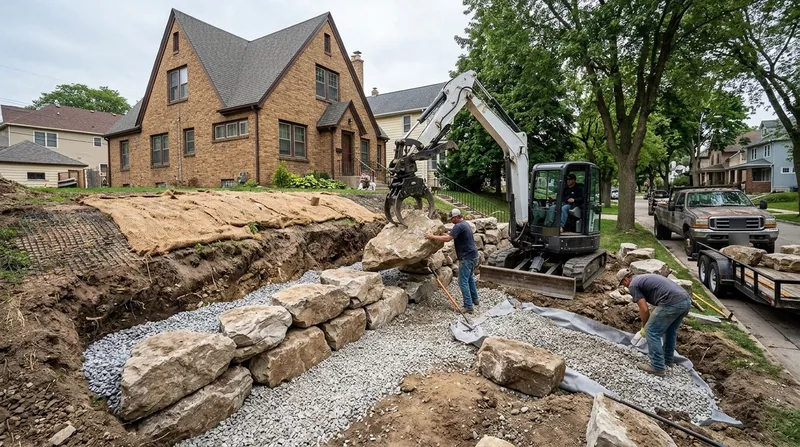




Boulder & Natural Stone Walls in Milwaukee solve a problem that poured concrete and segmental block cannot: they hold a ravine slope or a Lake Michigan bluff yard while looking like they grew out of the ground. We set Wisconsin fieldstone and Lannon stone on a compacted, drained base, machine-placed for tight joints and a face that reads natural from the kitchen window. The city's terrain is not flat: the East Side and North Shore bluffs, the Milwaukee, Menominee and Kinnickinnic river ravines, and the terraced front yards on rolling streets in Washington Heights and Sherman Park all create real grade changes. Those grades need mass, batter and drainage, not a stack of rock. If you are still weighing materials, start with our retaining wall installation overview, then come back to boulder work for the finish.
Why Natural Stone Walls Fit Milwaukee's Bluffs, Ravines and Old Lots
Milwaukee's dense glacial clay holds water, and hard freeze-thaw winters with deep frost heave push walls out of line. A boulder wall with proper batter and a gravel drainage core moves that water instead of fighting it. On the Lake Michigan bluffs and in the river ravines, natural stone also handles the settlement that comes with slope movement far better than a rigid poured wall. And on 1900s-1920s lots in Bay View, Riverwest and Walker's Point, Lannon stone walls already exist, so a natural stone repair or extension matches what was there before.
- We match existing Lannon stone and Wisconsin fieldstone so repairs blend into the original wall face.
- We build with a battered face and a compacted gravel base to resist frost heave, not just to look good.
- We install drainage stone and weep paths behind the wall so clay soil does not load the stones with water.
- We size and place boulders by machine so each stone seats on two points and locks into the course.
- We keep the wall below or above the local permit threshold, and we verify that threshold with the City of Milwaukee building department before work starts.
That combination is why natural stone holds up on slopes where timber and railroad ties have already rotted out.
Key info: A Story Hill homeowner had a 30-inch Lannon stone wall bowing out under a clay bank. We reset the face, added drainage stone and rebuilt the top course with matching stone, and the wall now reads as original from the sidewalk.
Permit rules vary by jurisdiction, and many Milwaukee-area departments require a permit for walls above roughly 4 feet measured from the footing, or when the wall supports a driveway or structure. Check the City of Milwaukee Department of City Development for the current threshold before you build.
How We Build a Boulder Wall on a Milwaukee Slope
We do not drop rock on dirt and call it a wall. Every boulder wall starts with excavation to the footing depth the slope and frost line demand, then a compacted crushed-stone base. We set the first course, check batter and line, and build up in lifts with drainage stone behind the face. On ravine lots in Wauwatosa and Brookfield we often tie the wall into a slope stabilization plan so the bank above the wall does not keep moving.
- We walk the slope, check soil and water, and confirm the wall height and permit status with the local building department.
- We excavate to the footing, compact the subgrade and set a crushed-stone base that sheds water.
- We place the first course by machine, check line and batter, and seat each stone on two contact points.
- We build up in lifts, backfill with drainage stone and filter fabric, and keep weep paths clear.
- We cap the wall, grade the soil above it away from the face, and clean the site before we leave.
Done in that order, a natural stone wall on a Milwaukee slope holds its line through frost heave instead of leaning into the yard.
Key info: On a ravine lot in Wauwatosa, we rebuilt a failed timber wall as a 3-foot boulder wall with a gravel drainage core. The bank above it stopped sliding, and the homeowner kept the natural look the lot already had.
Boulder Wall Approaches We Use in Milwaukee
Not every slope wants the same wall. We pick the approach from the soil, the height, the water and the look you want from the house and the street.
| Approach | Description | Best for |
|---|---|---|
| Dry-stacked boulder wall | Machine-placed boulders stacked with tight joints and no mortar, backed with drainage stone. | Garden terraces and walls up to about 4 feet. |
| Lannon stone wall | Wisconsin Lannon stone laid in courses to match existing walls and Cream City brick homes. | Repairs and extensions on older East Side and Bay View lots. |
| Fieldstone boulder wall | Locally sourced fieldstone set with a battered face and a compacted gravel base. | Ravine and lakeside landscaping where a natural look matters. |
| Engineered boulder wall | Taller or loaded walls built to stamped drawings with geogrid and a designed drainage core. | Walls above 4 feet or walls that support a driveway or structure. |
| Boulder terrace and steps | Tiered boulder walls with stone steps built into a rolling front yard. | Terraced yards in Washington Heights and Sherman Park. |
Each of these approaches is built to move water and hold line through a Milwaukee winter, not just to look right on day one.
Boulder & Natural Stone Walls Cost in Milwaukee: What to Expect
Most natural stone walls in Milwaukee start around $25 per square foot of wall face, and that figure moves with height, stone type and access. A 2-foot garden terrace on a flat Wauwatosa lot sits near the low end. A 5-foot engineered wall on a Lake Michigan bluff, with machine access limited and drainage detail added, runs well above it. Taller walls, tiered walls, tight side yards in Bay View and walls that need geogrid all add labor and material. Getting two or three estimates is smart because the scope differences show up in the numbers, and our full pricing overview lays out what each line item covers.
What to Look for in a Retaining Wall Contractor Near Milwaukee
Natural stone work rewards experience, so ask questions before you sign. A contractor who has built boulder walls on ravine lots will talk about drainage, batter and frost depth without being prompted. One who only talks about the stone face is guessing at the part that fails.
- Confirm the contractor is fully insured and ask for a certificate before work starts.
- Get two or three written estimates with scope, stone type and drainage detail spelled out.
- Ask for references from jobs in Milwaukee, Wauwatosa or Brookfield and go look at the walls.
- Check the permit threshold with the local building department, and ask whether engineered drawings are required for your wall height.
- Ask about HOA rules and property-line setbacks before the first stone is placed.
When the answers are specific, you are talking to the right crew. You can reach us through our contact and free estimate page to start the conversation.
Boulder & Natural Stone Walls in Milwaukee: Pricing Guide
| Service | Price | Details |
|---|---|---|
| Dry-stacked boulder wall | Starting at $25/sq ft | Includes excavation, compacted base, machine-placed boulders and drainage stone behind the face. |
| Lannon stone wall repair or extension | Starting at $35/sq ft | Includes matching Lannon stone, resetting the face and rebuilding the top course to blend in. |
| Engineered boulder wall | Starting at $45/sq ft | Includes stamped drawings, geogrid, a designed drainage core and inspection for walls above 4 feet. |
| Complex or large-scale job | On estimate | Bluff and ravine walls with limited machine access need an on-site look before a number. |
| Travel | Included | in Milwaukee and surrounding areas, no separate call-out or mileage fee. |
| Estimate | Free | Response within 24h at (414) 250-0691, no obligation to book. |
Indicative pricing, the exact cost depends on square footage, finish, and site access. Free personalized estimate within 24h at (414) 250-0691.


