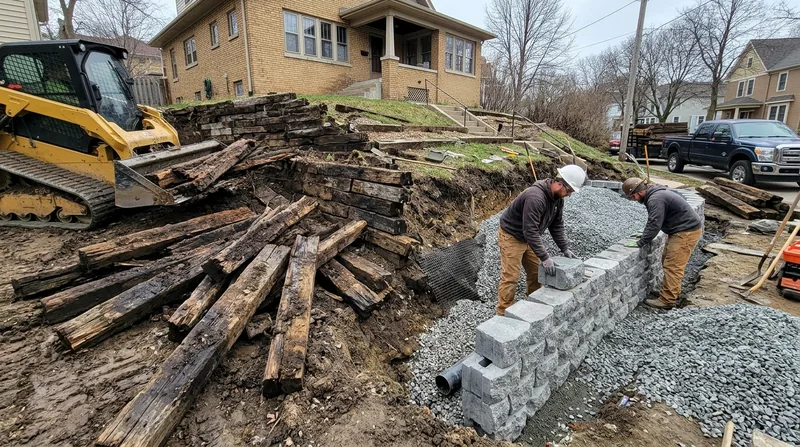




Railroad Tie Wall Replacement in Milwaukee: Retire the Creosote and Rebuild It Right
Railroad Tie Wall Replacement in Milwaukee is the job we get called for most on the city's older residential blocks, and for good reason. Those 1980s and 1990s timber walls were built with creosote-soaked ties that were never meant to last four decades in dense glacial clay. From Bay View's narrow Polish flat lots to the terraced front yards in Washington Heights and the ravine properties off the Menomonee River, those ties are now rotting, leaning, and leaching. We remove them, haul them away legally, fix the drainage that killed them, and rebuild in segmental block, poured concrete, or Lannon stone. If your wall is already bulging, start with our leaning and collapsed wall repair page before the structure moves further.
Milwaukee's hard freeze-thaw cycle is the real executioner. Deep frost heave pushes saturated tie walls out of line every single winter, and the grey lake-effect winters we get here do not give that wood a break. A wall that looked plumb in October can be kicked out three inches by March.
Why Railroad Tie Walls Fail Faster in Milwaukee Than Anywhere Else
Milwaukee sits on dense glacial clay that holds water like a bathtub. When a timber wall was backfilled with clay and no gravel, that water has nowhere to go, so it saturates the ties, freezes, expands, and shoves the whole face forward. Add the city's deep frost line and you get a failure mode that dominates here: frost heave combined with rotted tie faces, not insect damage and not UV decay.
- Creosote ties rot from the inside out, so the wall looks intact until a section caves.
- Clay backfill traps water against the wood and accelerates the decay.
- Missing weep holes and gravel drainage let hydrostatic pressure build behind the wall.
- Frost heave lifts and rotates the top courses every winter, opening gaps at the joints.
- Creosote is a regulated waste material, so removal and disposal require proper handling.
Once a tie wall has rotated more than a few degrees, patching it is money down the drain. Replacement is the only fix that holds.
Key info: A Riverwest homeowner called us about a tie wall behind a 1920s duplex. Three courses had heaved out six inches and the clay behind it was saturated. We rebuilt it in segmental block with a gravel drainage chimney, and it has held through two full frost cycles.
For official guidance on what triggers a permit, check the City of Milwaukee Department of Neighborhood Services before you schedule any work: city.milwaukee.gov/DNS.
How We Replace a Railroad Tie Wall in Milwaukee, Step by Step
We do not just pull ties and drop block in the same hole. The old wall failed because of water and frost, so the rebuild has to solve both. Every replacement starts with a site read of the grade, the soil, and where the water is actually going. Here is the sequence we run on a typical Milwaukee job.
- We mark utilities and confirm the property line before any digging starts.
- We cut and remove the creosote ties and haul them to a permitted disposal facility.
- We excavate to the footing depth required for Milwaukee's frost line.
- We pour or compact a proper base and set the first course dead level.
- We install gravel backfill, filter fabric, and weep holes so water exits the wall.
- We build the wall in segmental block, poured concrete, or Lannon stone to match the house.
- We cap, backfill, and compact, then clean the site and walk it with you.
If the wall is on a ravine lot or a steep terraced yard, we bring in our slope stabilization and erosion control crew so the grade above the wall does not keep feeding it.
Key info: On a Wauwatosa ranch with a tie wall holding up a driveway apron, we could not reuse the existing base because the clay had pumped. We over-excavated 18 inches, brought in compacted gravel, and rebuilt in poured concrete. The driveway has not settled since.
Replacement Approaches We Use on Milwaukee Tie Walls
The right replacement material depends on height, load, and what the house is wearing. A Cream City brick cottage in Walker's Point and a Tudor revival in Story Hill do not want the same wall. This table shows how we match the approach to the property.
| Approach | Description | Best for |
|---|---|---|
| Segmental block replacement | Engineered block with gravel drainage and geogrid, built to frost depth. | Most residential tie walls under 4 feet on flat Milwaukee lots. |
| Poured concrete replacement | Reinforced concrete wall with formed face and integrated drainage. | Driveway surcharges and taller walls that need engineered drawings. |
| Lannon stone rebuild | Natural stone face set on a concrete base with proper weep holes. | East Side and North Shore homes where the stone has to match. |
| Boulder and natural stone | Rock wall keyed into the slope with gravel behind it. | Ravine lots and terraced yards where a hard face fits the grade. |
We size the drainage and footing to the wall, not to a generic spec sheet, because Milwaukee frost does not negotiate.
Railroad Tie Wall Replacement Cost in Milwaukee: What to Expect
Most tie wall replacements in Milwaukee start around From $35/sq ft for a standard segmental block rebuild with new drainage. That figure covers removal, haul-away, base, block, and gravel. The number moves up with height, access, and what is sitting above the wall.
Cost drivers we price on every estimate:
- Wall height and length, plus how deep the footing has to go below frost.
- Access for equipment, which is tight on narrow Bay View and Riverwest lots.
- Creosote disposal fees, which are higher than standard demolition debris.
- Surcharge loads such as a driveway, patio, or structure above the wall.
- Material choice, with Lannon stone and boulder running above standard block.
- Engineered drawings when the wall is tall, tiered, or holds a surcharge.
Get two or three written estimates and compare scope, not just the bottom line. A cheap bid that skips gravel drainage will cost you again in five winters. Our full pricing overview breaks down what each tier includes.
Hiring a Retaining Wall Contractor Near Me in Milwaukee: What to Check
Replacing a tie wall is not a weekend project, and the contractor you pick matters more than the block you choose. Ask for proof before anyone touches the wall. A fully insured crew protects you if something goes wrong on a tight lot.
- Confirm the contractor is fully insured, and ask for a certificate of insurance.
- Get at least two or three written estimates with itemized scope and drainage details.
- Ask for local references on tie wall replacements, not just new installs.
- Verify who pulls the permit if your wall is above roughly 4 feet or holds a surcharge.
- Check setback and property-line rules with the local building department before work starts.
If a contractor cannot explain how they will handle water behind the wall, keep looking. Reach out through our contact page and we will walk your site and give you a straight answer.
Railroad Tie Wall Replacement Near Me: Milwaukee Neighborhoods We Serve
We replace tie walls across Milwaukee and the surrounding suburbs, from the lakefront bluffs to the river ravines. If your wall is in Wauwatosa, West Allis, or Brookfield, we run crews there weekly. Same crew, same drainage spec, same frost-depth footing.
Call (414) 250-0691 and we will schedule a free estimate.
Railroad Tie Wall Replacement in Milwaukee: Pricing Guide
| Service | Price | Details |
|---|---|---|
| Segmental block tie wall replacement | Starting at $35/sq ft | Includes tie removal, haul-away, gravel drainage, and block; height and access move the price |
| Poured concrete replacement | Starting at $55/sq ft | Reinforced wall with formed face and drainage; surcharge loads and engineered drawings raise it |
| Lannon stone or boulder rebuild | Starting at $65/sq ft | Natural stone face on concrete base with weep holes; stone availability and matching drive cost |
| Complex or large-scale job | On estimate | Tiered walls, ravine lots, and surcharge walls need an on-site look before pricing |
| Travel | Included | In Milwaukee and surrounding areas, no separate call-out or mileage fee |
| Estimate | Free | Response within 24h at (414) 250-0691, no obligation to book |
Indicative pricing, the exact cost depends on square footage, finish, and site access. Free personalized estimate within 24h at (414) 250-0691.


