



Retaining Wall Drainage in Milwaukee: Keeping Clay, Frost, and Water From Pushing Your Wall Out
Milwaukee sits on a shelf of dense glacial clay, and that clay is the reason so many Lannon stone, poured concrete, and segmental block walls in Bay View, Riverwest, and Washington Heights lean, crack, or bow within a decade. Water trapped behind a wall turns that clay into a heavy, expanding mass that pushes outward every time the ground thaws. Retaining Wall Drainage in Milwaukee is the work that lets that water leave before it does damage, through drain tile, weep holes, gravel backfill, and waterproofing that relieve hydrostatic and frost pressure. We install and rebuild these systems on walls from the Lake Michigan bluffs to the terraced front yards off Kinnickinnic Avenue. If your wall already shows movement, start with leaning and collapsed wall repair before drainage alone can help.
Why Drainage Decides Whether a Milwaukee Retaining Wall Survives
Most wall failures we open up in Milwaukee were never a block problem. They were a water problem. The soil here is heavy clay with low permeability, so rain and snowmelt sit against the back of the wall instead of draining down through it. Add a hard freeze-thaw cycle with deep frost heave and you get a wall that creeps out of line a few inches every winter, especially on north-facing slopes in Shorewood and Whitefish Bay where the ground stays frozen longer.
- Water saturates the backfill and adds lateral pressure the wall was never designed to carry.
- Frost heave lifts and shoves the wall face out of plumb as the ground freezes.
- Clay soils hold water against the wall and starve the drain tile if it was never installed.
- Weep holes clog with silt, so the wall has no relief point at the base.
- Tree roots and downspouts dump concentrated water behind walls on narrow city lots.
Correcting drainage early is almost always cheaper than rebuilding a wall that has already rotated. That is the single most useful thing a homeowner in Milwaukee can know about their wall.
Key info: A 1950s brick ranch in Wauwatosa had a 3-foot poured concrete wall along the driveway that bowed 2 inches in two winters. The wall had no drain tile and the downspout discharged right behind it. We added a gravel trench, perforated pipe, and filter fabric, rerouted the downspout, and the wall stopped moving.
Milwaukee County and the City of Milwaukee Department of Neighborhood Services handle permits for walls above roughly 4 feet or walls that support a surcharge; check the Milwaukee Department of Neighborhood Services for the current threshold before you build or rebuild.
How We Build Drainage That Works in Milwaukee Clay
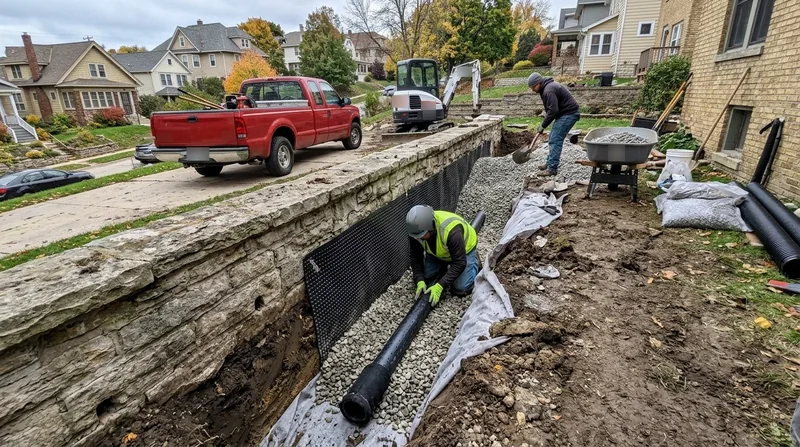
We do not just punch a few holes in a wall and call it drainage. We open the back of the wall, look at what the water is actually doing, and build a system that moves it away from the structure. On a typical Milwaukee job we work from the top of the wall down so the excavation stays stable and we can see the condition of the existing backfill and footing.
- We excavate behind the wall and remove saturated clay and failed backfill down to the footing.
- We install perforated drain tile at the base, wrapped in filter fabric and set in washed gravel.
- We core or rebuild weep holes at the low points so water has an exit through the wall face.
- We backfill with clean gravel and filter fabric to keep clay from clogging the stone.
- We waterproof the wall face where the wall is below grade and add a drainage board on taller walls.
- We tie the system to a daylight outlet, a dry well, or a sump so water leaves the site.
- We restore the surface, regrade to shed water away from the wall, and test the flow before we leave.
Every step is aimed at one outcome: no standing water against the back of the wall when the spring thaw hits.
Key info: On a tiered Lannon stone wall in Washington Heights, the upper wall was draining directly into the lower wall's backfill. We separated the two systems with independent drain tile runs and separate outlets, which ended the chronic damp basement corner the homeowner had fought for years.
If your wall is timber or railroad tie and already rotting from wet soil, drainage work pairs with railroad tie wall replacement so the new wall starts with a proper drainage bed.
Drainage Approaches We Use on Milwaukee Walls
Not every wall needs the same system. A low garden wall on a flat Greenfield lot is a different job from a tall wall holding a driveway on a ravine lot near the Menomonee River. We match the approach to the wall height, the soil, and where the water can legally go.
| Approach | Description | Best for |
|---|---|---|
| Drain tile and gravel trench | Perforated pipe at the footing in washed gravel with filter fabric to keep clay out. | Most walls over 2 feet in clay soil |
| Weep holes and face drains | Cored or rebuilt outlets at low points that let water exit the wall face. | Poured concrete and CMU walls |
| Waterproofing and drainage board | Membrane on the wall face plus a dimpled board that channels water down to the tile. | Tall walls and walls below grade |
| Surface regrading and downspout rerouting | Reshaping the top grade and moving roof water away from the wall. | Walls with runoff problems from above |
| Daylight or dry well outlet | A legal discharge point so collected water leaves the wall area entirely. | Walls with no natural downhill outlet |
We choose the combination that fits your wall and your lot, not a one-size kit.
Retaining Wall Drainage Cost in Milwaukee: What to Expect
Drainage work starts at From $2,500 for a straightforward wall where we can open the back, install tile and gravel, and restore the surface without heavy access work. That figure covers a typical residential wall of moderate height on an accessible lot. Most Milwaukee homeowners land above that starting point once wall length and site conditions come into play.
What moves the number: wall length and height, how much saturated clay has to be excavated and hauled, whether the wall is poured concrete, CMU, Lannon stone, or segmental block, and whether the outlet has to run a long distance to daylight. Tight access on a narrow Bay View lot, a wall that also needs structural repair, and tiered walls with multiple drainage runs all add cost. We price the outlet and the restoration separately so you can see where the money goes.
Get two or three estimates and compare scope, not just the bottom line. A low bid that skips filter fabric or leaves the outlet short will cost more in five years. Our full pricing overview breaks down the ranges.
Retaining Wall Drainage Near Me: How to Vet a Contractor Around Milwaukee
Drainage is invisible work, so the contractor matters as much as the materials. Ask for proof of licensing and insurance before anyone digs, and get a written scope that names the pipe, the gravel, the fabric, and the outlet. Call references on jobs at least two winters old, because that is when drainage problems show up in this climate.
Confirm who pulls the permit if your wall is above the local threshold or supports a driveway or structure. Ask how the contractor will protect mature trees and landscaping during excavation, and check any HOA or historic-district rules before work starts. A contractor who hesitates on these questions is telling you something.
Ready to talk through your wall? Contact us for a free estimate and we will look at the wall, the grade, and the water before we quote.
Retaining Wall Drainage in Milwaukee: Pricing Guide
| Service | Price | Details |
|---|---|---|
| Basic drain tile and gravel behind existing wall | Starting at $2,500 | Includes excavation, perforated tile, washed gravel, filter fabric, and surface restoration on an accessible wall. |
| Weep holes and face drainage on concrete or CMU | Starting at $2,900 | Coring or rebuilding outlets at low points, plus clearing clogged silt from existing weep holes. |
| Waterproofing and drainage board on tall wall | Starting at $4,200 | Membrane and dimpled board on the wall face, priced by wall height and square footage. |
| Tiered or multi-run wall drainage | On estimate | Separate drainage runs and outlets for each tier require an on-site look before pricing. |
| Travel | Included | In Milwaukee and surrounding areas, no separate call-out or mileage fee. |
| Estimate | Free | Response within 24h at (414) 250-0691, no obligation to book. |
Indicative pricing, the exact cost depends on square footage, finish, and site access. Free personalized estimate within 24h at (414) 250-0691.


